
Bonds vs Debt Mutual Funds: What’s Actually Different
Bonds vs Debt Mutual Funds

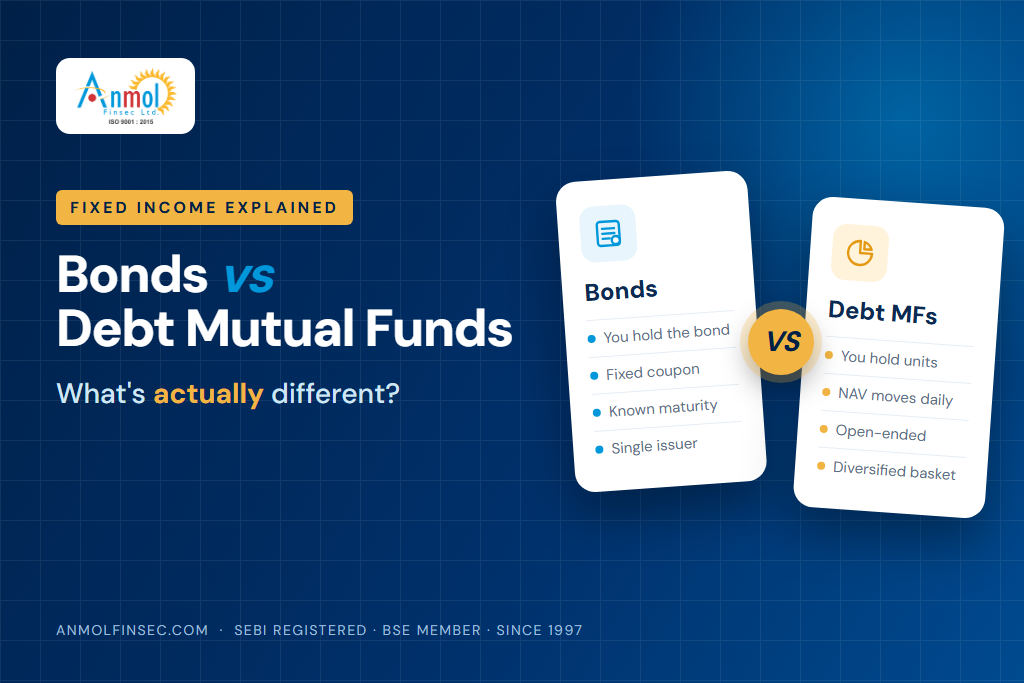
Bonds vs debt mutual funds is one of the most common questions we get from investors looking for stability outside equity. Both sit in the "fixed income" bucket, but they work very differently, carry different risks, and are taxed differently. Here is a clear, side-by-side look at the difference between bonds and debt mutual funds, so you can match the right product to your goal.

Quick answer: A bond is a direct loan to a government or company that pays a fixed interest (coupon) and returns your principal on a known maturity date. A debt mutual fund pools money from many investors to hold a diversified basket of bonds, so its value (NAV) changes daily with interest rates and it usually has no fixed maturity payout. For debt fund units bought on or after 1 April 2023, all gains are taxed at your income tax slab rate, regardless of holding period.

Bonds vs debt mutual funds: why they get confused

“Debt” and “fixed income” are used loosely to describe anything that isn’t equity. But a government bond you hold directly and a debt mutual fund are structurally different products, with different risks, different liquidity and, since 2023, very different tax treatment.

What is a bond?

When you buy a bond, you are lending money to the issuer (the Government of India, a state government, a PSU or a company) for a fixed period at a fixed rate of interest, called the coupon. You know three things upfront:

  • the coupon rate and how often it is paid,
  • the maturity date, and
  • the amount you get back at maturity, assuming the issuer does not default.

Common types of bonds available to Indian investors include Government Securities (G-Secs) and Treasury Bills, State Development Loans, PSU bonds, corporate bonds and NCDs, and tax-free bonds in the secondary market. Retail investors can buy G-Secs directly through RBI Retail Direct, and listed corporate bonds through a broker or a SEBI-registered Online Bond Platform Provider.

Key risks in bonds:

  • Interest rate risk: bond prices move opposite to interest rates. This matters only if you sell before maturity.
  • Credit risk: the issuer may delay or fail to repay. Check the credit rating (AAA, AA, etc.) before buying.
  • Liquidity risk: many bonds trade thinly, so selling early can mean accepting a lower price.

What is a debt mutual fund?

A debt mutual fund pools money from many investors and invests it in a portfolio of bonds, government securities and money market instruments. You don’t own any single bond. You own units, and the NAV of those units reflects the combined market value of everything the fund holds.

This gives you diversification across many issuers, professional management and easy liquidity (most open-ended debt funds can be redeemed on any business day). What you give up is the certainty of a fixed payout on a fixed date.

Debt funds come in several categories defined by SEBI, including liquid and overnight funds, short-duration funds, corporate bond funds, banking and PSU funds, gilt funds and dynamic bond funds. Each carries a different mix of interest rate and credit risk, so “debt fund” is not one product.

A middle option: Target Maturity Funds. These are debt index funds or ETFs that hold bonds maturing around a fixed date and are wound up on that date. They offer some of the predictability of a bond with the diversification and smaller ticket size of a fund, although returns are still not guaranteed.

Bonds vs debt mutual funds: key differences at a glance

FactorDirect BondsDebt Mutual Funds
What you holdA single issuer’s debtUnits of a diversified basket of debt instruments
Maturity payoutFixed and known upfrontNo fixed maturity (except target maturity funds); value depends on NAV
IncomeRegular coupon (monthly, half-yearly or annual)No fixed income; returns come through NAV growth
LiquidityDepends on the secondary market; can be thinHigh; most funds can be redeemed on any business day
DiversificationLow, unless you build a bond ladderHigh, across many issuers and maturities
Minimum investmentOften higher per bondLow; SIP-friendly
CostsBrokerage / spread on purchaseAnnual expense ratio
TaxationCoupon taxed as income; capital gains by holding period and listing statusGains on units bought after 1 April 2023 taxed at slab rate

Debt mutual fund taxation vs bond taxation

Tax is the part of the bonds vs debt mutual funds comparison that most investors miss, and it changed twice in recent years: first from 1 April 2023, and again from 23 July 2024.

Debt mutual fund taxation

  • Units bought on or after 1 April 2023: all gains are treated as short-term and taxed at your income tax slab rate, however long you hold them. There is no indexation benefit.
  • Units bought before 1 April 2023: if held for more than 24 months, gains are long-term and, for sales on or after 23 July 2024, taxed at 12.5% without indexation. If held for 24 months or less, gains are taxed at your slab rate.

Bond taxation

  • Coupon interest is added to your income and taxed at your slab rate in the year you receive it.
  • Listed bonds sold before maturity: held for more than 12 months, gains are long-term and taxed at 12.5% without indexation; held for 12 months or less, they are taxed at your slab rate.
  • Unlisted bonds and debentures: capital gains are taxed at your slab rate, regardless of holding period.

Tax rules change with Budget announcements and depend on your individual situation. Please confirm the current rules with your tax advisor before acting. See our Budget 2026-27 takeaways for investors for the latest changes.

Bonds vs debt mutual funds: which is right for you?

Bonds and debt mutual funds solve different problems. Use your goal, not convenience, to decide.

  • Choose a direct bond (or a target maturity fund) if you need a known amount on a known date, such as funding a child’s fees three years from now, and you are comfortable holding to maturity.
  • Choose a debt mutual fund if you want to park money with good liquidity and diversification, such as an emergency fund or money waiting to be deployed into equity.
  • Use both if you want regular income from a few high-quality bonds and a liquid cushion in a debt fund.

When investors compare bonds vs debt mutual funds, the mistake we see most often is treating “debt” as one bucket and picking whatever is easiest to buy, without matching the product to the goal or checking how the 2023 and 2024 tax changes affect their specific holdings. If you are also weighing fixed deposits, read our comparison of SIP vs lump sum vs FD, and see how debt fits into a balanced portfolio in 6 tips for portfolio diversification.

How Anmol Finsec can help

Since 1997, Anmol Finsec has helped investors in Ahmedabad, across Gujarat and NRIs decide between bonds vs debt mutual funds based on their goals, tax bracket and liquidity needs. Explore our bonds and debt investment services or book a consultation for a review of your fixed income portfolio.

Bonds vs debt mutual funds: frequently asked questions

What is the main difference between bonds and debt mutual funds?

A bond is a single loan to one issuer with a fixed coupon and maturity date. A debt mutual fund holds many bonds and money market instruments; you own units whose NAV moves daily, and there is usually no fixed maturity payout.

Are debt mutual funds still tax-efficient after the 2023 change?

Less than before. Gains on units bought on or after 1 April 2023 are taxed at your slab rate with no indexation benefit, which narrows the tax advantage debt funds used to have over FDs and other fixed-income options.

Is a bond safer than a debt mutual fund?

Not automatically. For a bond, safety depends on the issuer's credit quality; for a debt fund, it depends on the fund's holdings. Government securities carry very low credit risk, while corporate bonds and funds holding lower-rated paper carry more.

Can I lose money in a debt mutual fund?

Yes. Debt fund NAVs can fall, particularly when interest rates rise sharply or when the fund holds lower-rated paper that faces repayment problems.

Should I hold bonds directly or through a fund?

It depends on how much you are investing, whether you need a fixed maturity date, and how much diversification you want. Larger investors with a fixed goal date often prefer direct bonds or target maturity funds; smaller or flexible investments usually suit debt funds. This is worth a portfolio-specific conversation rather than a one-size-fits-all answer.

Disclaimer: This article is for educational purposes only and is not investment or tax advice. Tax rules are subject to change and depend on individual circumstances; please consult a qualified tax professional. Mutual fund investments are subject to market risks; read all scheme-related documents carefully. Bonds carry credit, interest rate and liquidity risk.

2 Comments

Leave a Reply

Your email address will not be published. Required fields are marked *