

SIP vs Lump Sum vs FD: Which is Right for Your Goals?
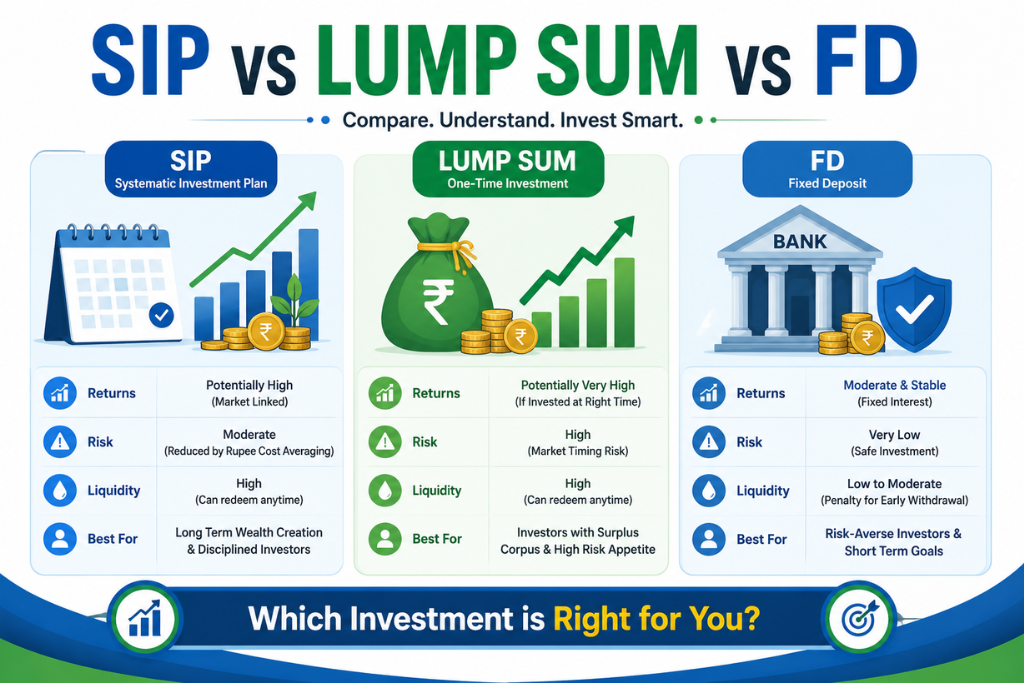
SIP vs Lump Sum vs FD: Which is Right for Your Goals?
Many people want to invest, but they get confused between three common options:
SIP, lump sum investment, and fixed deposit.
The question is simple: Should I invest every month through SIP?
Should I invest one big amount at once?
Or should I keep my money safely in an FD?
The answer depends on your goal, time period, and risk comfort.
There is no one perfect option for everyone. Let us understand this in simple language.
Quick Answer
SIP is useful when you want to invest small amounts regularly for long-term goals.
Lump sum is useful when you already have a large amount and can stay invested for the long term.
FD is useful when you want safety, fixed interest, and money for short-term needs.
Many investors may need a mix of all three.
What is SIP?
SIP means Systematic Investment Plan.
In simple words, SIP means investing a fixed amount regularly in a mutual fund.
For example, you invest ₹5,000 every month in a mutual fund.
You do not need to invest a big amount at once.
SIP helps you build investment discipline.
It is useful for long-term goals like:
- Child education
- Retirement planning
- Wealth creation
- Buying a house in future
- Long-term financial planning
SIP works well when you give it time.
But remember, SIPs are usually linked to mutual funds. Mutual funds are market-linked. This means returns are not fixed or guaranteed.
Benefits of SIP
SIP is easy to start.
You can begin with a small monthly amount.
It also helps you avoid the stress of market timing.
When markets are high, your SIP buys fewer units.
When markets are low, your SIP buys more units.
This is called rupee cost averaging.
SIP is useful for people who earn regular income, like salaried professionals, business owners, and young investors.
What is Lump Sum Investment?
Lump sum means investing a large amount at one time.
For example, you invest ₹5 lakh in a mutual fund at once.
This can happen when you receive:
- Bonus
- Business profit
- Property sale money
- Maturity amount from another investment
- Large savings amount
Lump sum can work well if you have a long time period and can handle market ups and downs.
But it needs more care.
Why?
Because if you invest a big amount just before the market falls, your investment may go down in the short term.
That is why lump sum investment should be planned properly.
Some investors also use STP, which means Systematic Transfer Plan. In this method, the large amount is not invested at once.
It is slowly moved into mutual funds over time.
Benefits of Lump Sum Investment
Lump sum investment can be useful when you have extra money and want to invest it for the long term.
It can also be useful when the market is reasonably valued and you are comfortable with risk.
But lump sum is not for everyone.
It is better for investors who understand market movement and can stay calm during short-term falls.
What is a Fixed Deposit?
Fixed Deposit, or FD, is one of the most common saving options in India.
In FD, you deposit money with a bank or financial institution for a fixed time.
The interest rate is decided at the start.
For example, you deposit ₹2 lakh for 1 year at a fixed interest rate.
FD is simple to understand.
You know the interest rate.
You know the time period.
You know when you will get the money back.
That is why many people trust FDs.
Benefits of FD
FD is useful when safety is your main priority.
It is suitable for:
- Emergency fund
- Short-term goals
- Senior citizens
- Conservative investors
- Money needed within 1 to 3 years
FD returns are usually lower than long-term equity mutual funds, but they are more stable.
FDs are not linked to daily stock market movement.
That makes them useful for people who do not want high risk.
SIP vs Lump Sum vs FD: Simple Comparison
Point | SIP | Lump Sum | FD |
Meaning | Invest small amount regularly | Invest big amount at once | Deposit money for fixed interest |
Risk | Market-linked | Market-linked | Lower risk |
Return | Not fixed | Not fixed | Fixed interest |
Best For | Long-term regular investing | Large surplus money | Short-term safety |
Good For Beginners | Yes | Only with guidance | Yes |
Liquidity | Depends on fund type | Depends on fund type | Depends on FD terms |
Market Impact | Averaged over time | Higher timing impact | No direct market impact |
Main Benefit | Discipline | Full amount gets invested | Safety and fixed interest |
Is SIP Better Than FD?
SIP and FD are different.
SIP is better for long-term wealth creation if you can accept market risk.
FD is better for safety and short-term goals.
For example, if you need money after 6 months or 1 year, FD may be better.
But if you are investing for 10 years, SIP in mutual funds may be considered for long-term growth.
So, SIP is not always better than FD.
It depends on your goal.
Is Lump Sum Better Than SIP?
Lump sum can be better when you have a large amount and can stay invested for many years.
But SIP is easier for most people because it reduces the pressure of timing the market.
For beginners, SIP is usually simpler.
For experienced investors, lump sum can work if it is planned carefully.
Can I Do SIP and FD Both?
Yes.
In fact, many investors should use both.
FD can protect short-term money.
SIP can help with long-term goals.
For example:
- Emergency fund: FD
- Child education after 12 years: SIP
- Retirement after 20 years: SIP
- Money needed next year: FD
- Bonus received: Lump sum or STP
This balanced approach can make your financial plan stronger.
Which Option is Right for Your Goal?
Choose FD if:
- You want safety
- You need money soon
- You do not want market risk
- You want fixed interest
Choose SIP if:
- You want to invest monthly
- Your goal is long-term
- You can handle market ups and downs
- You want disciplined investing
Choose lump sum if:
- You already have a large amount
- You have a long-term goal
- You understand market risk
- You can stay invested without panic
Simple Rule to Remember
Use FD for safety.
Use SIP for discipline.
Use lump sum for planned long-term deployment of surplus money.
Do not choose only by return.
Choose by goal.
Common Mistake Investors Make
Many investors ask:
“Which gives the highest return?”
That is not the right first question.
The better question is:
“When do I need this money?”
If you need the money soon, safety matters more.
If your goal is far away, growth matters more.
If you are confused, you may need a mix of SIP, FD, and lump sum investment.
Final Thought
SIP, lump sum, and FD are not enemies.
They are different tools.
A smart investor knows when to use which tool.
Your investment should match your goal, risk comfort, and time period.
At Anmol Finsec, we help investors understand SIPs, mutual funds, FDs, and wealth planning in simple language.
If you are unsure how to balance SIPs, lump sum investments, and FDs, speak to our team.
Use our SIP Calculator or talk to us about balancing SIPs and FDs for your financial goals.
Internal Links:
- Mutual Funds & SIP Planning
- Wealth Management
- Contact Us
Disclaimer: Mutual fund investments are subject to market risks. Fixed deposit rates may change from time to time. Please consult your financial advisor before making investment decisions.
Is SIP better than FD?
SIP may be better for long-term wealth creation, but it carries market risk. FD may be better for short-term safety and fixed interest. The better option depends on your goal.
Can I do both SIP and FD?
Yes. Many investors use FD for safety and SIP for long-term growth. A mix can help balance risk and return.
Is lump sum better than SIP?
Lump sum can work when you have a large amount and a long-term view. SIP is easier for regular monthly investing and reduces timing pressure.
Which is best for beginners?
SIP and FD are easier for beginners. Lump sum investment should be done carefully, preferably after understanding risk and time horizon.
Which is good for short-term goals?
FD is usually better for short-term goals because returns are fixed and market risk is lower.
Leave a Reply